


Changes on 457 VISA

Changes from April 2017

From 19 April 2017, for the existing 457 visa:

– Occupation lists: The occupation lists that underpin the 457 visa will be significantly condensed from 651 to 435 occupations, with 216 occupations removed and access to 59 other occupations restricted.

– Of the 435 occupations, access to 24 occupations has been restricted to regional Australia (e.g. occupations relating to farming and agriculture).

– The Consolidated Sponsored Occupation List (CSOL) will also be renamed as the new Short-term Skilled Occupations List (STSOL) and will be updated every six months based on advice from the Department of Employment.

– The other occupations list used for skilled migration, the Skilled Occupations List (SOL) will be renamed the new Medium and Long-term Strategic Skills List (MLTSSL). This list will contain occupations that have been assessed as being of high value to the Australian economy and aligning to the Government’s longer term training and workforce strategies.

– A separate fact sheet about the occupation lists’ changes will be issued.

– Validity period: The maximum duration of 457 visas issued from this date for occupations that are on the STSOL will be two years. Occupations on the MLTSSL will continue to be issued for a maximum duration of four years.
Fact sheet one: Reforms to Australia’s temporary employer sponsored skilled migration programme—abolition and replacement of the 457 visa | 2
Changes from July 2017
From 1 July 2017, for the existing 457 visa:
– Occupation lists: The STSOL will be further reviewed based on advice from the Department of Employment. The MLTSSL will be revised based on outcomes from the Department of Education and Training’s 2017-18 SOL review.
– English language requirements: English language salary exemption threshold, which exempts applicants whose salary is over $96,400 from the English language requirement, will be removed.
– Training benchmarks: Policy settings about the training benchmark requirement will be made clearer in legislative instruments.
– Character: Provision of penal clearance certificates will become mandatory.

Changes by December 2017

Before 31 December 2017, for the existing 457 visa:
– The Department of Immigration and Border Protection (the Department) will commence the collection of Tax File Numbers for 457 visa holders (and other employer sponsored migrants), and data will be matched with the Australian Tax Office’s records to ensure that visa holders are not paid less than their nominated salary.
– The Department will commence the publication of details relating to sponsors sanctioned for failing to meet their obligations under the Migration Regulation 1994 and related legislation.

Changes from March 2018

From March 2018, the 457 visa will be abolished and replaced with the TSS visa. The TSS visa will be comprised of a Short-Term stream of up to two years, and a Medium-Term stream of up to four years.
The Short-Term stream is designed for Australian businesses to fill skill gaps with foreign workers on a temporary basis, where a suitably skilled Australian worker cannot be sourced.
The Medium-Term stream will allow employers to source foreign workers to address shortages in a narrower range of high skill and critical need occupations, where a suitably skilled Australian worker cannot be sourced.
The Short-Term stream will include the following criteria:
– Renewal: Capacity for visa renewal onshore once only.
– Occupations:
o For non-regional Australia, the STSOL will apply.
o For regional Australia, the STSOL will apply, with additional occupations available to support regional employers.
– English language requirements: A requirement of an International English Language Testing System (IELTS) (or equivalent test) score of 5, with a minimum of 4.5 in each test component.
– Genuine entry: A genuine temporary entrant requirement.
Fact sheet one: Reforms to Australia’s temporary employer sponsored skilled migration programme—abolition and replacement of the 457 visa | 3
The Medium-Term stream will include the following criteria:
– Renewal: Capacity for visa renewal onshore and a permanent residence pathway after three years.
– Occupation lists:
o For non-regional Australia – the MLTSSL will apply.
o For regional Australia – the MLTSSL will apply, with additional occupations available to support regional employers.
– English language requirements: a requirement of a minimum of IELTS 5 (or equivalent test) in each test component.
Eligibility criteria for both streams will include:
– Work experience: at least two years’ work experience relevant to the particular occupation.
– Labour market testing (LMT): LMT will be mandatory, unless an international obligation applies.
– Minimum market salary rate: Employers must pay the Australian market salary rate and meet the Temporary Skilled Migration Income Threshold requirements.1
– Character: Mandatory penal clearance certificates to be provided.
– Workforce: A non-discriminatory workforce test to ensure employers are not actively discriminating against Australian workers.
– Training requirement: Employers nominating a worker for a TSS visa will be required to pay a contribution to the Skilling Australians Fund. The contribution will be:
o payable in full at the time the worker is nominated;
o $1200 per year or part year for small businesses (those with annual turnover of less than $10 million) and $1800 per year or part year for other businesses.
The detailed policy settings for several of these requirements will be finalised through the implementation process. Further details on these requirements to inform stakeholders will be available in due course.

RSMS

rsmsRegional Sponsored Migration Scheme (RSMS) (Subclass 187)

Regional Sponsored Migration Scheme (Subclass 187) enables the employers in the regional area who are experiencing labour shortage from the local residents to overcome this issue by employing skilled overseas workers and aiding them to apply for a valid visa to legitimatise their stay in Australia. Successful visa applicants are obliged to work under the sponsoring employer for 2 years after the grant of the visa.

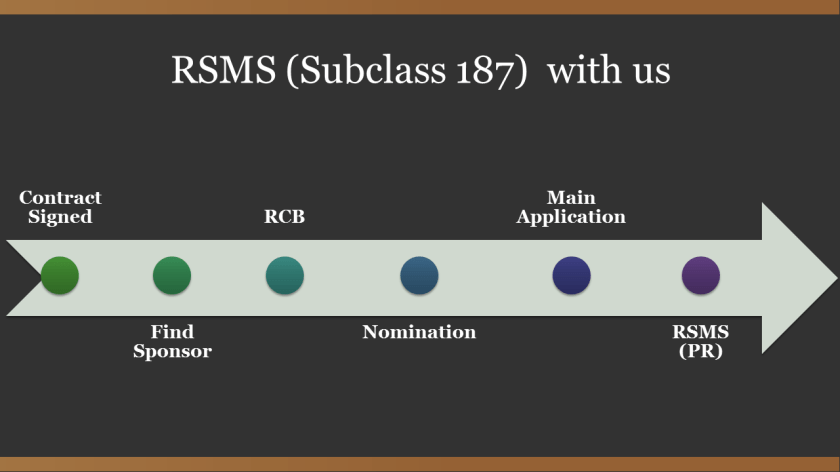
To apply for RSMS Subclass 187 visa, valid applications must be made in 3 steps, namely, Regional Certifying Body, Nomination, and Visa Application, to the Department of Immigration and Border Protection (DIBP). Upon its grant, the visa applicants will enjoy the benefits of being an Australian Permanent Resident. There are 3 pathways in applying for an Australian Permanent Residency through RSMS.

Temporary Residence Transition Stream – This stream allows the holders of Subclass 457 visa, who has completed 2 years of employment under a sponsoring employer to apply for an Australian Permanent Residency. Successful applicants must be nominated for RSMS visa by the same employer who has nominated the applicant for their Subclass 457 visa. To apply, the visa applicants must:

  • Hold Subclass 457 visa, and have worked for 2 years under a same employer and nominated position
  • Prove English proficiency equivalent to 5.0 in all components in International English Language Test System

Direct Entry Scheme – The Direct Entry Scheme for RSMS is offered to highly skilled and experienced overseas workers who can demonstrate their understanding of the nominated work. Applicants for this stream must show that:

  • They have an approved or a pending nomination by the sponsoring employer for a position under this stream
  • They hold English proficiency level of at least 6.0 in all components in International English Language Testing System (IELTS), or equivalent
  • They hold a valid skills assessment in the nominated occupation, if necessary

Agreement Scheme – An employer that holds a labour agreement can provide sponsorship for RSMS for eligible applicants in accordance with the terms and conditions of the Agreement. Successful visa applicants must meet the requirements, such as age, skills, experience, and English, outlined in the Agreement.

Processing time

Stream 75 per cent of applications processed 90 per cent of applications processed
Temporary Residence Transition stream 12 months 14 months
Direct Entry stream 22 months 24 months
Agreement stream Unavailable due to low volume of applications. Unavailable due to low volume of applications.

Last updated 19 June 2018 (for month ending 31 May 2018)

186 ENS

Employer Nomination Scheme (ENS) (Subclass 186)

Employer Nomination Scheme (Subclass 186) is designed to attract skilled and experienced workers into Australia in certain industries as sought necessary by the Australian government. It is a Permanent Resident visa purposely for the skilled overseas workers who wish to work and live in Australia permanently. There are 3 pathways in applying for an Australian Permanent Residency through Employer Nomination Scheme. In each pathway, there are 2 steps in making a valid and successful application, namely, Nomination, and Visa Application.

Temporary Residence Transition Stream – This stream allows overseas workers who have worked full time for the sponsoring employer for 2 years under Subclass 457 visa to apply for an Australian Permanent Residency through ENS.  It is one of the most popular methods pursued by overseas workers for a successful migration into Australia. Successful visa applicants must be nominated for an ENS by the same employer who has nominated the applicant for their Subclass 457 visa. To be eligible, the applicants must:

  • Hold Subclass 457 visa, and have worked for 2 years under a same employer and nominated position
  • Prove English proficiency equivalent to 5.0 in all components in International English Language Test System

Direct Entry Scheme – Skilled and experienced overseas workers may directly apply for ENS through a Direct Entry Scheme, which, upon its grant, renders the applicants Australian Permanent Residency. Applicants for this stream must show that:

  • They have an approved or a pending nomination by the sponsoring employer for a position under this stream
  • They hold English proficiency level of at least 6.0 in all components in International English Language Testing System (IELTS), or equivalent
  • They have at least 3 years of work experience in relevant field
  • They hold a valid skills assessment in the nominated occupation

Agreement Scheme – An employer that holds a labour agreement can provide sponsorship for ENS for eligible applicants in accordance with the terms and conditions of the Agreement. Successful visa applicants must meet the requirements, such as age, skills, experience, and English, outlined in the Agreement.

20.Oct

Job Sponsorship Available List for 457 & RSMS

1. Accountant (General)
2. Graphic Designer
3. Web Designer
4. Electrical Engineer
5. Electrical Engineer
6. Registered Nurse (Aged Care)
7. Registered Nurse (Child & Family)
8. Web Developer
9. Telecommunications Engineer
10. Building Associate
11. Web Administrator
12. Automotive Electrician
13. Motor Mechanic
14. Bricklayer
15. Carpenter and Joiner
16. Carpenter
17. Joiner
18. Painting Trades Workers
19. Electrician
20. Cabler
Etc.

Fair Work grants interim suspension to PIA

30-09-2016 –

The Fair Work Commission has granted an interim order of suspension to all protected industrial action (PIA) after an application from the Department of Immigration and Border Protection (DIBP).

The order takes effect at 9 pm tonight (30 September) and applies to all Community and Public Sector Union (CPSU) members in the Department of Immigration and Border Protection—including the Australian Border Force—who have been undertaking PIA.

All staff are expected to return to normal rostered duty from that time so business as usual operations can resume.

The suspension order will remain in effect while the Fair Work Commission considers the matter. A hearing has been scheduled for 5 October 2016. Further orders will be made at or after that time.

The decision to seek assistance from the Fair Work Commission to secure a suspension of PIA was taken today after much deliberation. This decision was not taken lightly.

Media contact: Immigration and Border Protection (02) 6264 2244

Man arrested for internal importation of cocaine at Melbourne Airport

29-09-2016 –

A 52-year-old British man was arrested at Melbourne International Airport on Friday, 16 September 2016, for attempting to import approximately 280 grams of cocaine.

It will be alleged he swallowed 39 separate pellets which contained the cocaine.

The man arrived in Melbourne on a flight from Los Angeles and was selected for further examination by Australian Border Force (ABF) officers.

Following an examination which revealed the presence of the pellets, the ABF referred the man to the Australian Federal Police (AFP), who transported him to hospital for further examination. The examination confirmed the man was carrying a number of pellets internally.

A total of 39 pellets containing approximately 280 grams of cocaine were recovered, and he was subsequently charged with importing a marketable quantity of a border controlled drug, namely cocaine, contrary to section 307.1(1) of the Criminal Code 1995 (Cth). He appeared before Melbourne Magistrates Court on Wednesday, 21 September 2016, and was remanded to appear again on Wednesday, 14 December 2016.

ABF Regional Commander, James Watson, said ABF officers were experts at identifying a range of concealment methods.

“We have sophisticated technology which will detect those who try to smuggle drugs internally,” Commander Watson said.

“The individual has put his own life at risk through this highly dangerous method of attempting to smuggle narcotics.

“Even though the man has survived this dangerous method of importation, he now faces very serious charges which could result in penalties of up to 25 years in jail.”

AFP Commander Paul Osborne, Manager Crime Operations, said the AFP and its partners would continue to work closely to disrupt drug importation attempts.

“It is disappointing to continue to see the extent to which individuals will go to import drugs in to Australia,” Commander Osborne said.

“Not only are they putting their own lives at risk, they are endangering the lives of others with the product they are looking to sell.”

Media enquiries:

Immigration and Border Protection (02) 6264 2244
AFP Media (02) 6131 6333

Apprehension of foreign fishing vessel in Australian Waters

23-09-2016 –

In a major hit to illegal fishing in Australian waters, Maritime Border Command (MBC) within the Australian Border Force (ABF) and the Australian Fisheries Management Authority (AFMA) have apprehended a Papua New Guinea (PNG) fishing vessel fishing illegally on Thursday 22 September 2016.

The Australian Defence Vessel (ADV) Cape Byron boarded the PNG registered fishing vessel about 2.7nm inside the Australian Economic Exclusion Zone (AEEZ), west of Thursday Island.

The vessel was initially identified by HMAS Adelaide on Monday 19 September and was seen crossing into the AEEZ by an MBC surveillance aircraft on Thursday.

Officers from ADV Cape Byron boarded the vessel and located 500 kilograms of fresh fish and about 9 tons of fish in freezer compartments.

The 29 people on board the fishing vessel were detained and will be brought to Australia for further investigation by AFMA.

Commander MBC, Rear Admiral Peter Laver praised the joint efforts of Maritime Border Command and the Australian Fisheries Management Authority and said the apprehensions highlight the capability of both agencies.

“Australia’s maritime domain exceeds 10 million square kilometres, but no matter where these boats are, MBC and AFMA officers will continue to work tirelessly to ensure that Australia’s waters remain free from illegal fishing,” Rear Admiral Laver said.

“We maintain continuous watch and response capability within the AEEZ to deter where possible, but intercept and apprehend illegal foreign vessels who attempt to conduct illegal activity in Australian waters.”

AFMA’s General Manager Fisheries Operations, Peter Venslovas, agreed saying the continued joint efforts of MBC and AFMA ensures Australia’s marine resources are protected from poachers and remain healthy.

“Australia’s well managed Commonwealth fisheries are tempting for foreign fishing vessels. It is the continued cooperation between AFMA and MBC that ensures poachers will be caught,”

“Those attempting to steal from our marine environments should be on notice – they will be caught.”

This apprehension comes a day after 16 foreign fishermen from Vietnam were convicted of illegally fishing within Australian waters. Each fisherman received suspended sentences and their vessel was confiscated by AFMA and destroyed.

More information on how Australia is working to combat illegal fishing can be found at afma.gov.au.

Media enquiries: Immigration and Border Protection (02) 6264 2244

Geelong man charged with the importation of firearm magazines

23-09-2016 –

A 30-year-old Geelong man has been charged with nine offences relating to the alleged importation and possession of prohibited items including firearm magazines, knives and a ballistic vest.

The man was arrested on 13 July, after the Australian Border Force (ABF) conducted an investigation which led to the execution of a Customs Act search warrant on the man’s Norlane residence, with the support of Victoria Police.

During the warrant activity, investigating officers found a variety of ammunition of varying calibre, a ballistic vest and knives, knuckle dusters and other weapons.

Following an initial hearing in Geelong in September, the man will appear again before the Geelong Magistrate’s Court on 23 December 2016 charged with:

  • two counts of importing prohibited imports in contravention of Section 233BAB(5) of the Customs Act 1901; and
  • seven counts of possessing prohibited imports, in contravention of Section 233(1)(d) of the Customs Act 1901.

ABF Acting Commander Immigration and Customs Enforcement, Craig Palmer, said that the ABF is committed to protecting the community from dangerous prohibited goods.

“The safety of our community is a priority for the Australian Border Force and we will continue to work with our partner agencies to ensure this safety is maintained,” Acting Commander Palmer said.

If convicted, the man faces a maximum penalty of up to 10 years’ imprisonment.

Media contact: Immigration and Border Protection (02) 6264 2244

ABF cancels licence of company linked to undeclared cigarettes

The Australian Border Force (ABF) has cancelled the licence of a NSW company linked to the movement of 832,000 undeclared cigarettes.

The company, QSL Freight Forwarding Pty Ltd, was licensed under s77G of the Customs Act 1901 to hold goods subject to Customs control at its depot in Mascot, NSW.

It had been operating for just nine weeks before ABF officers executed search warrants on Wednesday 10 August at four Sydney residential addresses in Bass Hill, Roselands and Chipping Norton. A further two search warrants were executed at the depot and a licensed customs broker in Botany.

The warrants were in relation to an ongoing ABF investigation into the movement of cigarettes subject to Customs control without authority and without the payment of the substantial duty and GST that was due.

The ABF alleges that QSL Freight Forwarding Pty Ltd was involved in the movement of the 832,000 undeclared cigarettes, which were being held under Customs control at another licenced s77G depot, in order to deliberately defraud the revenue.

During the warrants, ABF officers served the director of QSL Freight Forwarding Pty Ltd with a Notice of Intended Cancellation and Suspension of the Customs Depot Licence pursuant to s 77V of the Customs Act 1901. This meant the depot licence was immediately suspended with full cancellation taking effect on Tuesday, 23 August 2016.

QSL Freight Forwarding Pty Ltd’s access to the Integrated Cargo System, which supports the movement and reporting of goods across the Australian border, has also been revoked.

The investigation resulted from an ABF air cargo examination team detection and a broader ABF intelligence informed operation focussed on identifying, targeting and investigating criminality within the cargo supply chain.

Media contact: Immigration and Border Protection (02) 6264 2244

19.Sep

Job available list

1. Massage Therapist (457/RSMS)

2. Cook/Chef in Restaurant & Café (457/RSMS)

3. Café & Restaurant Manager (457/RSMS)

3. Customer Service Manager (RSMS)

4. Manufacture Production Manager (457)

5. All kinds of Engineers (457/RSMS)

6. Welders (457)

7. Accountant (457/RSMS)

8. Baker (457)

9. IT Field (457/RSMS)

10. Retail Store Manager (457/RSMS)

11. Pastry Chef (457)

12. Hairdresser (457/RSMS)